
Home
El Niño puts SADC’s breadbaskets, power grids and budgets on the line
- Details
- Written by: admin
- Category: SADC
- Hits: 98
A dry 2026/27 summer could turn a climate shock into a regional test of food trade, electricity security and government finances. Why did a region that could see the drought coming wait until it became a crisis?
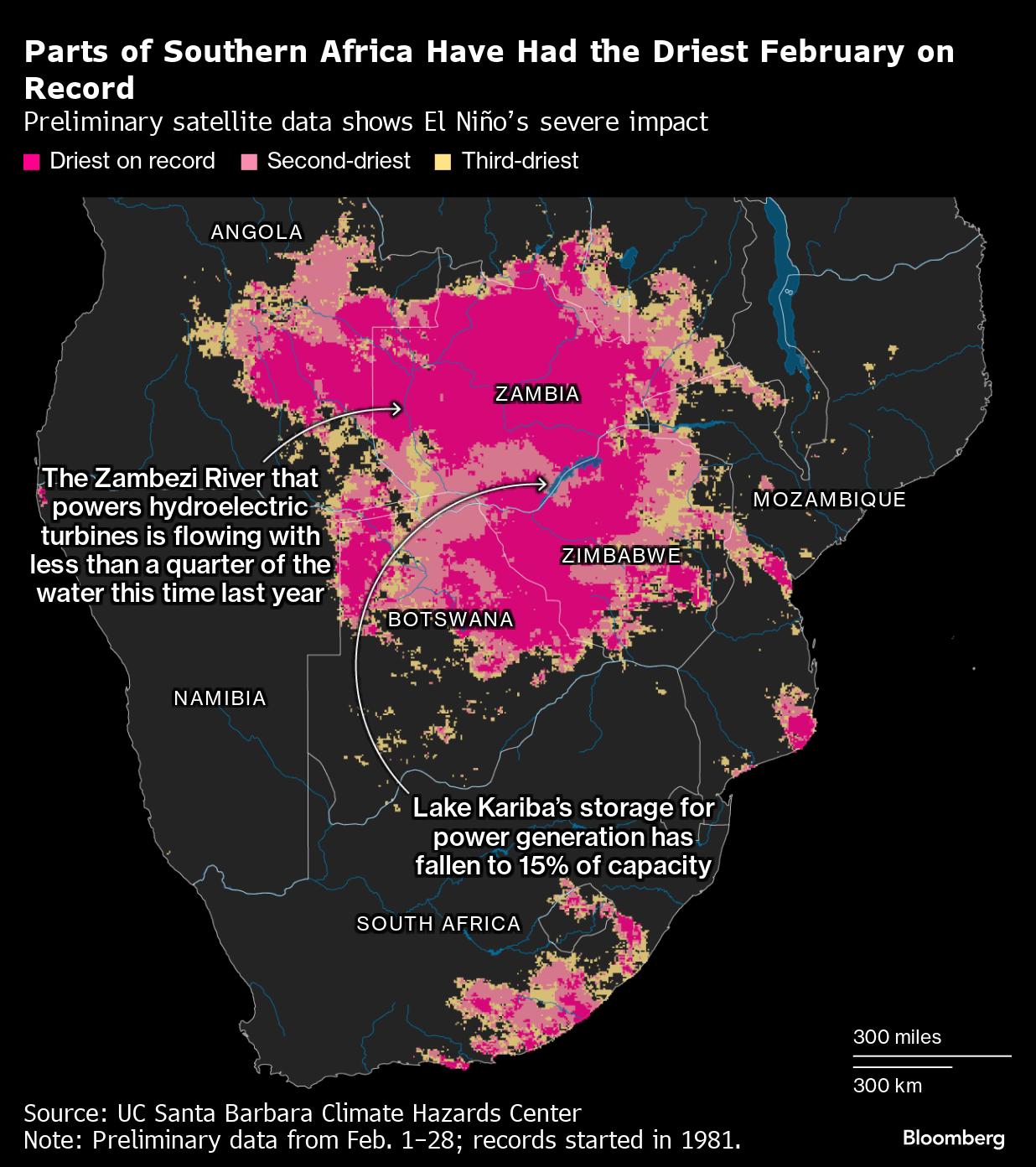
Southern Africa is heading towards a potentially difficult summer. But the real danger from the developing El Niño is bigger than failed crops. If the 2026/27 rainy season turns out as dry and hot as regional forecasts suggest, the shock could move rapidly through food prices, electricity systems, government budgets, foreign-exchange reserves and cross-border trade. That makes the coming summer not simply a weather story, but an economic and political test for SADC.
Large parts of Angola, Namibia, Botswana, southern Zambia, Zimbabwe, Mozambique, South Africa, Eswatini and Lesotho face increased chances of below-normal rainfall, while temperatures are expected to run unusually high across much of the region. The north and north-east could tell a different story, with parts of Tanzania, the Democratic Republic of Congo, northern Zambia and northern Malawi potentially receiving better rainfall. That unevenness is important. Southern Africa may simultaneously confront drought, local flooding and damaging heat.
For governments, however, the political-economic danger lies in the concentration of dry conditions across some of the region's major agricultural, livestock, hydropower and industrial economies.
A drought that could travel across borders
SADC has seen this sequence before. Rain fails in one country. Grain production falls. Imports rise. Governments seek more dollars to pay for food. Neighbouring states begin protecting their own supplies. Maize prices climb. Livestock farmers compete for feed. Hydropower production weakens. Electricity shortages hit industry. What begins as a rainfall deficit becomes a regional economic shock.
The 2023/24 drought was a reminder of how interconnected those risks have become. Zambia, Zimbabwe and Malawi declared drought disasters, while food insecurity spread across the wider region. Another major El Niño so soon afterwards would hit households and governments that have had limited time to rebuild buffers. The central question is therefore no longer merely how much rain will fall? It is whether SADC can stop a climate shock in one country from becoming a food, energy and inflation shock in several others.
South Africa becomes even more important
South Africa enters the season with one major advantage: a relatively healthy grain position following stronger agricultural production. That gives the region an important cushion. But it also highlights Southern Africa's dependence on one country as a food-security backstop. When harvests fail elsewhere, South African maize often moves north into Botswana, Namibia, Zimbabwe, Mozambique, Eswatini and Lesotho. A substantial South African crop failure would therefore have consequences far beyond its borders. The risk is not that South Africa suddenly runs out of food. The more immediate danger is that exportable surpluses shrink at exactly the moment neighbouring countries need more imports.
Prices would respond first. That could become particularly uncomfortable for countries with weak currencies or limited foreign-exchange reserves. Imported maize may still be physically available, but considerably more expensive in local currency. For SADC, South Africa's summer grain belt has effectively become a piece of regional strategic infrastructure.
Zambia and Zimbabwe: when rainfall becomes electricity
Nowhere is the relationship between weather and the wider economy clearer than Zambia and Zimbabwe. Both depend heavily on the Zambezi River system and Lake Kariba for electricity. The lake enters the coming season in a considerably stronger position than during the depths of the recent drought. But another weak rainfall year would again raise questions about future inflows and hydropower generation.
That matters enormously for Zambia. Copper mining is electricity intensive and central to the country's exports, government revenue and foreign-exchange earnings. Severe load-shedding therefore does more than inconvenience households: it can weaken the productive engine of the economy.
Zimbabwe faces similar pressures as electricity shortages constrain manufacturing, mining, agriculture and businesses already operating in a difficult economic environment.
The transmission chain is brutally simple: less rain → weaker river flows → lower hydropower output → more load-shedding → higher production costs → slower economic growth. For Zambia and Zimbabwe, El Niño can therefore simultaneously attack food production and electricity supply. That is why drought resilience and energy diversification are increasingly the same policy discussion.
Zimbabwe faces another agricultural gamble
Zimbabwe is particularly vulnerable to the timing of rainfall. Much of its staple agriculture remains rain-fed. Even where seasonal rainfall totals eventually appear respectable, prolonged dry periods during December or January can severely damage maize during critical stages of development. This is one reason climate scientists increasingly warn against judging agricultural risk purely from total seasonal rainfall. A crop does not consume rainfall statistics. It needs moisture at particular stages of growth. A three-week dry spell accompanied by extreme heat can therefore be more damaging than a modest reduction in total seasonal rainfall.
For Zimbabwe, the political implications are substantial. Another weak maize harvest could force greater food imports, increase pressure on household incomes and revive questions about government support for vulnerable communities. The country is encouraging drought-tolerant seed, conservation agriculture, water harvesting and irrigation, while increasingly promoting the productive use of dams for agriculture, fisheries and local economic activity. The challenge is implementation at sufficient scale.
Botswana and Namibia: cattle, water and rural wealth
In Botswana and Namibia, the threat is not only maize. Livestock is central to rural livelihoods and, in many communities, functions as stored household wealth. Drought destroys that wealth gradually. Pasture deteriorates. Water points come under pressure. Farmers buy additional feed. Animals lose condition. Eventually herds have to be sold into weak markets — often when many other farmers are trying to sell simultaneously. By the time drought relief arrives, households may already have lost assets built up over many years.
High temperatures worsen the problem because they increase evaporation from dams, soils and grazing land. This is why a slightly below-average rainfall season combined with exceptional heat can sometimes be more damaging than rainfall figures suggest. For Namibia and Botswana, water security, livestock management and drought policy are inseparable.
Mozambique and Malawi could face two emergencies at once
The regional picture becomes more complicated further east. Parts of Malawi and Mozambique could face substantial rainfall deficits, while northern areas may experience considerably wetter conditions. Mozambique could therefore find itself preparing for drought in central and southern districts while remaining alert to flooding and tropical systems further north. That places pressure on already stretched disaster-management budgets. It also illustrates an increasingly important reality: governments can no longer prepare for one national climate emergency. They may have to finance drought relief, flood response and agricultural support simultaneously.
The next shock could be food inflation
The most politically sensitive consequence may eventually appear not in fields or dams but in supermarkets. If harvests decline across several countries at once, maize and other food prices can rise rapidly. Governments then confront difficult choices. Should they subsidise food? Release strategic grain reserves? Cut import duties? Restrict exports? Provide drought relief? Increase social transfers? Or allow prices to rise and protect public finances?
Each response has regional consequences. An export restriction that protects consumers in one SADC country can make food more expensive in another. That is why the coming El Niño could test whether SADC acts as an economic community or simply as a collection of national markets when shortages emerge.
The temptation to close borders
Food shortages frequently produce political pressure for governments to "secure domestic supply". Export restrictions can be popular politically because they appear to keep food at home. But if several countries adopt them at once, the regional market begins to fragment. Import-dependent states are then forced to source grain further afield, increasing shipping costs, foreign-exchange requirements and delivery times. The better regional response would be early coordination: countries identifying likely deficits, expected surpluses, grain stocks, import requirements and transport bottlenecks before the shortage peaks. SADC already possesses regional structures for climate monitoring, food-security assessment and disaster coordination. The question is whether those systems can influence economic decisions early enough.
Drought can become a fiscal crisis
El Niño also arrives at an uncomfortable time for governments already facing pressure to fund infrastructure, health, education and social programmes. Drought adds another bill. Governments may have to finance food imports, agricultural inputs, livestock support, emergency water provision and social protection simultaneously.
Where hydropower fails, electricity imports or emergency generation add further costs. Economic growth can weaken at the same time. That means tax revenue may decline precisely when expenditure requirements are increasing. For highly indebted governments, a climate event can therefore become a fiscal event. And where currencies are already under pressure, greater food and energy imports can reinforce inflation.
Scientists say the rainfall total does not tell the whole story
Climate researchers offer an important qualification: El Niño increases drought risk, but it does not guarantee drought everywhere. Southern African rainfall is influenced by several interacting climate systems, including conditions in the Pacific and Indian oceans as well as regional atmospheric circulation. Very strong El Niño events have produced surprisingly different rainfall outcomes in the past. That uncertainty does not mean governments should ignore the forecast. It means they should use it intelligently.
Scientists increasingly argue for combining seasonal forecasts with shorter-range weather information, soil-moisture monitoring, vegetation conditions, dam levels and the actual onset and distribution of rainfall. The practical question for a farmer is not whether a meteorological agency predicts "70% probability of below-normal rainfall". It is whether to plant now, plant less, switch crop varieties, conserve seed or wait for the next rainfall window.
The academic sound bites
"El Niño is a risk multiplier, not a drought guarantee."
It shifts the odds. It does not dictate exactly what will happen in every district.
"For agriculture, the dry spell can matter more than the seasonal rainfall total."
Timing matters. Rain arriving after a crop has already passed a critical growth stage cannot reverse the damage.
"A regional climate outlook should trigger decisions, not simply discussion."
The economic value of forecasting lies in changing behaviour before losses occur.
And perhaps the most important:
"Early warning without early action is simply an earlier description of the disaster."
The solutions are known
Southern Africa is not short of proposed solutions. The most immediate is anticipatory action — releasing support before harvests fail rather than after households have exhausted their food and livestock. Farmers can be given drought-tolerant and early-maturing seed before planting. Livestock farmers can receive feed support before animals lose condition. Governments can pre-position grain and identify import requirements before prices spike. Water authorities can intensify conservation before reservoirs reach emergency levels.
Another priority is irrigation. Southern Africa cannot continue treating large-scale dependence on rain-fed agriculture as an unavoidable fact of geography. Small dams, groundwater, solar-powered irrigation, water harvesting and more efficient irrigation systems could dramatically reduce the vulnerability of rural economies.
Energy diversification is equally important. Solar, wind, battery storage and stronger regional electricity trading can reduce the economic damage caused when drought simultaneously hits hydropower systems. Crop insurance and disaster-risk financing can also transfer part of the cost away from households and state budgets.
But none of these measures works particularly well when introduced after the drought has already arrived.
This is ultimately a SADC test
The coming El Niño will test more than agricultural preparedness. It will test whether Southern Africa has learned to treat climate risk as a regional economic-security issue. Food, electricity, water and trade cross borders. So do the consequences when any of them fail.
South Africa's maize reserves matter to Lesotho and Zimbabwe. Kariba's water matters to Zambia and Zimbabwe. Mozambique's transport corridors matter to landlocked neighbours. Regional power markets matter when hydropower falters. That interdependence is precisely why a severe drought should not be managed solely through national emergency declarations after the event.
SADC has received the warning before the first major planting rains. The political question is what governments do with it. Because if the rains disappoint, leaders will eventually face a much harder question: Why did a region that could see the drought coming wait until it became a crisis?
Zambia’s Disputed Election Tests SADC’s Democratic Credibility
- Details
- Written by: admin
- Category: SADC
- Hits: 78
Zambia’s election result has been declared, but questions about counting, court access and accountability remain. SADC’s credibility will depend on how openly those questions are answered.
The result and the dispute
Zambians voted on 13 August 2026. The Electoral Commission of Zambia declared President Hakainde Hichilema the winner on 18 August, with approximately 60% of the vote against opposition challenger Brian Mundubile’s approximately 38%, according to AP’s report of the official result. Hichilema was inaugurated for a second term on 1 September.
The dispute concerns the process as well as the outcome. On 14 August, counting was temporarily suspended. The commission cited attacks on electoral officials and stolen ballot papers; counting subsequently resumed. Mundubile raised concerns about possible interference. The interruption alone does not prove manipulation. AP reported the interruption and competing explanations.
Political arrests added to the tension. AP reported on 27 August that police detained Mundubile over alleged treason. Earlier, authorities alleged that weapons and plans for an armed insurrection justified arrests of opposition figures; Mundubile denied those allegations. The UN human rights chief expressed concern. An allegation is not a conviction. The public interest is in evidence, due process and scrutiny of how state power is exercised.
What SADC observers found
The SEOM Preliminary Statement, issued on 15 August 2026 by Head of Mission Hon. Samuel B. Tembenu, is the official interim assessment—not a final verdict on the declared result.
Observers visited 277 of 13,529 polling stations and found calm conditions at 275. SEOM praised preparations and transparent handling of electoral materials. However, it identified gaps in party-finance legislation and ballot secrecy, and recorded concerns about media freedom. It distinguished direct observations from allegations it could not verify, including misuse of public resources.
Crucially, SEOM said it could not observe counting and collation during the suspension. It reserved further assessment of results management for its final report, promised within 30 days. Its recommendations included stronger ballot reconciliation and ending practices that could link ballots to identifiable voters.
These findings justify specific questions about safeguards and accountability. They do not establish that the declared winner lost. Equally, calm voting at observed stations cannot resolve what happened beyond the mission’s observation.
Court access needs a precise explanation
Reporting on a 25 August judiciary statement said the Chief Justice acknowledged receiving election-challenge documents at his private email address and referred them to the Constitutional Court to determine their legal effect. The report also described court-premises closures around the petition deadline.
Receiving an email and accepting a properly filed petition are not the same legal event.
Nor does the absence of a registered petition, by itself, resolve whether people had a practical opportunity to lodge one. A credible explanation should identify which filing channels remained available, what instructions litigants received and what the court decided about the documents. Those questions require records and rulings, not inference about motives.
What Malawi and Mozambique show
Malawi demonstrates the value of an effective remedy. Its courts annulled the 2019 presidential election, and the Supreme Court of Appeal upheld that decision. Lazarus Chakwera won the fresh vote in June 2020, as documented in the US State Department’s country report. The lesson is not that Zambia requires the same outcome. It is that evidence must have a credible route into an independent process.
Mozambique illustrates why observation cannot end with voting. Disputes following its 2024 election were accompanied by serious unrest. In November, SADC leaders addressed the post-election political and security situation and committed to engagement through the regional security organ. The relevant warning is about timing: confidence-building is harder once confrontation has deepened.
For Zambia, both examples point to the same priority: give electoral complaints a credible institutional response before mistrust hardens.
Three actions that would strengthen confidence
- Make the result traceable. The ECZ should provide accessible polling-station and constituency figures, explain corrections and document the counting interruption. SADC’s mission should assess whether the published record allows independent reconciliation with national totals. Any gaps should be identified and explained.
- Explain the legal pathway. Zambia’s judiciary should clarify filing arrangements, the status of attempted petitions and any relevant rulings. Police and prosecutors should make their allegations and procedural steps clear through lawful processes. Defendants must be able to contest the evidence; political disagreement cannot establish criminal guilt.
- Show the follow-through. SADC’s Organ on Politics, Defence and Security Cooperation should seek responses to observer recommendations and communicate the next steps. SADC can press for accountability and facilitate dialogue; decisions on Zambia’s legal disputes belong to its competent courts.
Credibility is earned after the declaration
The strongest regional response would neither endorse every opposition allegation nor treat the announced margin as an answer to every concern. It would distinguish proven events, contested claims and unanswered questions, then identify who must respond.
The ECZ should make the count independently traceable. The judiciary should explain how election challenges could be filed and what became of those submitted. SADC should publish its full findings and a clear programme of follow-up. Citizens deserve answers they can check, not another round of assurances.
Before 1994: Generations of Black Excellence
- Details
- Written by: News Correspondent
- Category: South Africa
- Hits: 154
Long before 1994, Black South Africans were building careers in scholarship, medicine, law and business. Their achievements reveal generations of ambition and expertise—and the opportunities segregation and apartheid denied to many more.


The scholar behind the street
Visitors to Vilakazi Street in Orlando West, Soweto, often come for Nelson Mandela. At number 8115 stands the house where he lived before imprisonment and to which he returned after his release. Nearby is the former home of Archbishop Desmond Tutu. The street connects two Nobel Peace Prize laureates, but its name honours a third South African whose story deserves attention.
Mandela House’s account of the street identifies its namesake as Benedict Wallet Vilakazi: poet, novelist, linguist and academic. His career places Black intellectual achievement at the centre of a history too often told only through political leaders.
Vilakazi received his doctorate in literature from Wits in 1946. The university records him as the first Black person in South Africa to earn that qualification in literature. His poetry helped shape modern isiZulu writing, while his collaboration with linguist Clement Doke produced a major Zulu–English dictionary. These were lasting contributions to scholarship, not simply symbolic breakthroughs.
He died in 1947, a year before the National Party came to power. His life therefore belongs to the history of segregation before formal apartheid. The distinction matters: the later regime imposed its restrictions on a society in which Black teachers, scholars and professionals were already building careers.
Scholarship: openings, exclusions and persistence
Institutions such as Fort Hare provided narrow but consequential routes into higher education. Fort Hare’s own history describes a college where Black, Coloured and Indian students studied together despite the segregation surrounding them. Its staff included ZK Matthews and D.D.T. Jabavu; its students went on to work across Southern Africa.
Matthews earned Fort Hare’s first degree in 1923 and later became vice-chairman of its senate and acting principal. His progress illustrates how one generation of graduates could help educate the next. The institution was more than a collection of exceptional individuals: it created relationships, intellectual traditions and routes into professional life.
Those openings were vulnerable. In 1959–60, the apartheid government took over Fort Hare and turned it into an ethnically designated college for Xhosa-speaking students. The university identifies that takeover as the end of its earlier multiracial character. Educational opportunity could be restricted by changing the institution itself.
At the University of Cape Town, AC Jordan worked in African languages from 1946 to 1962. His scholarship helped establish African languages and literature within the academy. UCT’s account of his legacy also records how the political situation forced him into exile. A university appointment offered neither security nor freedom from the state.
Archie Mafeje’s experience made the limits still more explicit. In 1968, UCT approved his appointment as a senior lecturer in social anthropology, then withdrew it under government pressure. UCT records the nine-day occupation by about 600 students that followed, and the university’s eventual apology to his family. Mafeje built a distinguished career abroad; the institution that had selected him failed to defend his appointment.
Later decades brought further gains. Mathematics educator T.W. Kambule joined Wits as a senior tutor in 1978. Chabani Manganyi arrived in 1981 as a senior research fellow and visiting professor, bringing work on psychology and Black experience. Writer and educator Es’kia Mphahlele became Wits’ first Black full professor and helped shape African literature as a field of study.
Together, these careers show change across generations. Black scholars were teaching students, producing research and extending the subjects universities considered worthy of study. Yet Mafeje’s exclusion remains a warning against treating those gains as evidence of equal access.
Medicine: expertise rooted in communities
Medical careers brought professional knowledge into communities underserved by the wider system. They also reveal why this history must include women whose work is sometimes overshadowed by more familiar male figures.
Mary Susan Malahlela-Xakana qualified at Wits in 1947, becoming South Africa’s first Black woman medical doctor. She established practices in Kliptown and Mofolo South and devoted decades to community healthcare. Wits records that forced removals under the Group Areas Act led her to close the Kliptown practice. Qualification did not protect a doctor—or her patients—from racial dispossession.
Nthato Motlana qualified in 1954 after studying at Fort Hare and Wits. His Soweto practice served ordinary residents as well as Mandela, Walter Sisulu and Tutu. South African History Online records that it treated people injured during the uprisings of the 1970s and 1980s. Motlana himself experienced banning and detention and was denied a passport for decades.
These surgeries were places where professional standing acquired a wider purpose. A doctor’s skill mattered to the patient in front of them, but sustained service also built trust, local networks and a measure of independence within segregated communities.
Mamphela Ramphele’s career connected medicine, activism and university leadership. Her published curriculum vitae records her medical qualification in 1972, her founding role at Zanempilo Community Health Centre from 1975, and her appointment as a UCT deputy vice-chancellor in 1991. It also records detention in 1976 and restriction to the Northern Transvaal from 1977 to 1983.
She was appointed UCT vice-chancellor in 1996; the university lists her term as 1997–2000. That democratic-era leadership grew out of medical practice, research and public engagement developed over the preceding decades.
Law: a profession confronting the system
Before Mandela became the world’s best-known political prisoner, he was a practising attorney. The Nelson Mandela Foundation’s timeline dates the opening of his law firm with Oliver Tambo to 1952.
The Foundation describes Mandela & Tambo as South Africa’s first Black legal firm and says much of its work involved defending Black victims of apartheid. Their professional lives therefore belong alongside their political biographies. Legal training gave them a way to assist people facing the consequences of a system they were also organising to change.
The significance reaches beyond two famous names. A Black legal practice challenged assumptions about who could possess expertise, represent clients and exercise professional authority. Its existence also made skilled assistance available to people whose encounters with the law were often encounters with racial power.
Business: building enterprises and institutions
Entrepreneurs faced a related challenge: converting ability and demand into businesses in an economy that restricted their opportunities. Richard Maponya saw commercial potential in Soweto and helped build enterprises serving it. His story is also a reminder that township residents were customers and economic participants, not merely a labour supply for the city.
In his official eulogy for Maponya, President Cyril Ramaphosa described denied licences and permits, difficulty obtaining land and credit, and raids by apartheid authorities. The tribute also recognised Marina Maponya’s contribution. Their success was built through sustained work under constraints that shaped what businesses could own and where they could operate.
Sam Motsuenyane helped turn the ambitions of individual businesspeople into collective organisation. His work with NAFCOC, founded in 1964, and the establishment of African Bank addressed two practical needs: representation and access to finance.
In a 2024 memorial address, Reserve Bank Governor Lesetja Kganyago recounted how Motsuenyane and his fellow founders raised capital from individuals and businesses, secured Barclays’ support and obtained a banking licence in 1975. Kganyago also acknowledged obstruction by Reserve Bank officials during the application process.
That history extends the argument beyond personal achievement. Building a business created livelihoods; building an organisation or a bank could help others gain a foothold. Neither removed the surrounding inequalities, but both expanded the resources Black communities could draw on.
Achievement—and the opportunity denied
These lives demand recognition, but they cannot tell us how many others were prevented from following similar paths. The people who qualified, published, practised or built businesses are visible in the record. Their success does not measure the talent lost to inadequate schooling, exclusion, forced removal or an unaffordable education.
Nor should this be read as a claim that every professional was a political activist, or that a shared racial experience produced a single outlook. The careers differed. What connects them here is the work of developing expertise and institutions under conditions that constrained Black advancement.
The democratic transition changed the terms of access and citizenship. It did not create the intellectual ability, professional ambition or entrepreneurial knowledge that would help shape the new South Africa. Those capacities had histories of their own: in classrooms and clinics, in legal practices, in scholarship and in businesses sustained across generations.
Vilakazi Street gives that continuity a visible form. Visitors remember Mandela and Tutu and the struggle for political freedom. The name on the street sign points further back, to a scholar who died before formal apartheid began and whose work outlasted it.
South Africa’s Black professional class did not suddenly appear when the doors opened in 1994. It had spent generations building the knowledge, skills and institutions those doors had been designed to keep out.
Europe Has Changed the Car Rules. South Africa Cannot Coast on R291bn in Exports.
- Details
- Written by: News Correspondent
- Category: South Africa
- Hits: 77
Europe has changed the rules. South Africa’s automotive industry now has to prove it can do more than assemble and export cars: it must recover materials, trace them and put them back to work. The country can build that capability—or leave another part of its industrial future to somebody else.
PRETORIA — South Africa exported a record R291 billion in vehicles and automotive components in 2025. Vehicle exports reached 414,271 units, according to naamsa’s Automotive Trade Manual 2026 release, published on 15 May 2026. That is an industrial achievement worth defending. But last year’s export record is no guarantee of a place on the next production line.
The European Union’s new end-of-life vehicle regulation extends environmental requirements into vehicle design, materials and recovery. South African producers need suppliers that can prove where recycled materials came from and how they were processed. A competitive factory needs a compliant supply chain behind it.
The next vehicle programmes will be won through engineering, investment and execution. South Africa needs to make its case before those decisions are taken. Waiting until an export order is in trouble is not an industrial strategy.
The export record is no shield
Naamsa reports that the EU and UK together received R182.8 billion, or 62.8%, of South Africa’s automotive export value in 2025. That concentration leaves South Africa heavily dependent on a narrow group of customers. Their changing requirements belong at the centre of industrial planning.
The real pressure point is factory scale. Export orders help support assembly lines, tooling, component contracts, logistics and engineering. Losing enough volume can weaken the economics of an entire operation, including production for customers unaffected by a particular rule. Conversely, complying early can help a supplier remain part of future vehicle programmes.
Brussels is reaching into the factory
The European Commission’s overview describes a framework covering the vehicle lifecycle, from design and production to collection, dismantling and recycling. The objective is to make parts and materials easier to recover and return to use, rather than treating recycling as a problem that begins at the scrapyard.
That changes the questions facing a manufacturer. Can a component be removed efficiently? Can its materials be separated? Can recovered material meet the quality required for a new part? Can the supplier produce reliable evidence? A technically suitable material may still be commercially difficult to use if its origin and processing cannot be demonstrated.
For an exporter, this work belongs in the design office, the purchasing contract and the supplier’s records. By the time the finished car reaches the port, it is too late to fix the supply chain.
The clock is running
The following milestones come from Regulation (EU) 2026/1738, particularly Articles 6 and 59. Different obligations have different start dates.
- 13 August 2026: Entry into force.
- 1 September 2028: General application date, with specified exceptions and transitional provisions.
- 14 August 2030: Conditions and independent-audit requirements apply to qualifying material recycled in third-country installations.
- 1 September 2032: Newly type-approved vehicle types must contain at least 15% post-consumer recycled plastic by weight of their plastic content.
- 1 September 2036: The corresponding target for newly type-approved vehicle types rises to 25%.
These are not blanket replacement deadlines for every vehicle already being manufactured. The regulation’s scope and transitional provisions matter. Further measures will determine recycled-metal requirements; steel and aluminium should not be presented as having a single, already-settled 2033 compliance deadline.
The calendar invites complacency. Automotive planning punishes it. Material testing, supplier qualification, tooling and investment approval happen years before a car reaches a showroom. South Africa has to work backwards from the programmes it wants to win—and start now.
A scrapyard is not yet a supply chain
South Africa already has vehicle manufacturers, component businesses, dismantlers and recyclers. The job is to connect them into a system that delivers consistent materials and credible records. Selling scrap is a transaction. Feeding a vehicle factory is an industrial capability.
A vehicle reaching the end of its life may contain reusable parts, recoverable metals and plastics, as well as fluids and components needing specialised treatment. The value of recovery depends on safe handling, separation, quality control and a customer willing to buy the output.
How the circular supply chain works
Collection → Safe dismantling → Material recovery → Quality checks and traceability → Manufacturing
Reusable parts can also move into repair and remanufacturing. Not every recovered material is suitable for a new automotive component.
Consider a plastic part removed from an old vehicle. Its route back into manufacturing requires more than collection: materials must be identified and separated, contamination controlled, the recovered plastic processed and its properties tested. The component maker then needs a dependable supply and documentation acceptable to its customer. This example puts the commercial test in plain sight: the material must meet a buyer’s specification. Manufacturers belong at the table from day one.
Build collection capacity without buyers and the country risks creating stockpiles. Ignore recovery capacity and manufacturers may have to import the recycled inputs. Neither outcome delivers the industrial value South Africa should be chasing.
Do not build the new industry by shutting workers out
In a statement dated 1 September 2026, the Motor Industry Staff Association called for a worker-centred end-of-life vehicle framework. MISA’s operations chief executive, Martlé Keyter, linked the proposal to safe working conditions, recognised qualifications and career paths for dismantlers, recyclers and technicians.
The union also called for transition support for informal operators. A framework that shuts capable small businesses out could destroy livelihoods and discard collection and repair networks the country already has. MISA is making the case for jobs; delivering them will take viable businesses and enforceable working standards.
Set standards and enforce them. Then make the route to compliance usable: training, technical guidance, affordable certification and access to buyers. A licence that a small operator cannot realistically obtain is a barrier, not a transition plan.
The policy discussion is already under way. Engineering News reported on 11 September 2026 that Parks Tau, speaking at the Eastern Cape Export Symposium on 20 August, identified an end-of-life vehicle policy as part of the response to the sector’s challenges.
Component makers face a double squeeze
Circularity arrives alongside electrification and changing expectations for industrial emissions. Component businesses must decide which products will remain in demand and which new capabilities justify investment. A supplier can face pressure on both its product range and its choice of materials.
Battery-electric vehicles do not use exhaust catalytic converters. Other opportunities may emerge in battery systems, thermal management and electrical components. But a slide deck is not a factory. Firms need customers, skills, finance and competitive production costs before an opportunity becomes an order.
Apply the same discipline to recycling and remanufacturing. Name the buyer. Define the specification. Secure the material. Show how the operation makes money. Regulation can create an opening; it cannot run the business.
Defend Europe. Stop depending on it so heavily.
South Africa should prepare for demanding European standards without making Europe its only industrial objective. Greater market diversity would reduce the concentration risk identified by the export figures.
A credible recovery and remanufacturing system could also serve domestic repair businesses and, over time, customers elsewhere in Africa. Winning that business will require competitive prices, workable logistics and knowledge of each market’s rules. Continental ambition needs customers behind it.
The strategic prize is capability that has value beyond a single regulation: trained workers, reliable material specifications, traceable supply chains and manufacturers able to adapt as their customers’ requirements change.
Enough diagnosis. Who delivers?
- Government: Coordinate an end-of-life vehicle framework across industry, environmental regulation and trade, with clear responsibilities and published implementation milestones.
- Manufacturers and component suppliers: Map affected vehicle programmes, specify material and documentation requirements, and test potential suppliers early.
- Recyclers and dismantlers: Develop safe treatment, separation and record-keeping systems around the requirements of actual buyers.
- Training and standards institutions: Build qualifications, testing capacity and accessible certification routes, including for smaller operators.
Judge the response by what gets built and qualified: suppliers ready to deliver, workers trained, materials meeting specifications and recovery operations earning their keep. Workshops and strategy launches are not the finish line.
South Africa already has factories, engineering expertise and export relationships worth defending. The missing connections between dismantlers, recyclers and manufacturers will not build themselves. Every year spent debating the need to act is a year lost to testing, training and investment.
Europe has written the rules. South Africa must now do the industrial work. Build the system, back the workers and win the next generation of orders. An export record is worth celebrating. It is not a plan.
Page 1 of 2